Thursday, September 27, 2012

An Odd Bond Between Mother & Son

http://www.riversidephotography.co.uk/images/gallery/mother-_-baby-1_1.jpg
A mother will always have a bond with her children like no other person will. Maybe the bond is just there, yet again maybe it can be scientifically explained. Research that has been recently conducted shows that a mother and child exchange cells during pregnancy. This is called microchimerism. It was first discovered in mice, but studies have shown that microchimerism happens in humans as well. During pregnancy, a defense system called the blood-brain barrier is significantly weaker which allows the mother and child to exchange cells. The fetal DNA can hang around in the mother's brain for years. 59 female brains were studied and 37 of them showed signs of fetal DNA in them. This shows that mother and child really do have a bond like no other. Fetal cells can help protect a mother from things such as breast cancer help the process of repairing tissue. That's great, but sadly 
http://www.gracewv.org/filerequest/1776
these cells can bring harm to the mother as well. Studies show a correlation between the number of pregnancies a woman had in her lifetime and her chance of getting Alzheimer's. Since this is a new discovery, many more tests need to be performed in order to say whether or not this exchanging of cells is safe for both mother and child. As for now though, we know that a bond between mother and child is actually very real. One that could potentially always be in our minds, literally.
Sources: http://mcc.blackboard.com/webapps/portal/frameset.jsp?tab_tab_group_id=_2_1&url=%2Fwebapps%2Fblackboard%2Fexecute%2Flauncher%3Ftype%3DCourse%26id%3D_5636_1%26url%3D

Mutations in Our Body

http://www.futurity.org/wp-content/uploads/2012/07/XChromosomes_1.jpg
When most people think of the word "mutation" a picture of an ugly monster or maybe even a zombie comes to their minds. Of course, these are types of mutations that today's society is most familiar with. Even Hollywood explains how zombies are formed by a mutation in genes in our bodies right? In reality, since zombies are only found in fictional movies and books, mutations happen every day. The scientific definition for a mutation is a change in the nucleotide sequence of DNA. Mutations occur in many different ways and are not always harmful. They can be caused by base substitutions, or replacing one nucleotide with another. Base substitutions can alter amino acids which cause the function of related proteins to change. Mutations can also be caused by removing a base nucleotide (deletion) or adding a base nucleotide (insertion). Both of these lead to a change in the amino acid sequence which again, changes proteins and their functions. So what are the causes of mutations? Well, sometimes they can be spontaneous and are simply caused by an error that occurred during DNA replication. These types of mutations are what cause evolution and plants and animals ability to adapt to the environment over time. We can also cause mutations by high-energy radiation or chemical exposure. Either of these can be very harmful. Mutations aren't always bad. In many ways, they can help us. Unless of course, there ever comes a time that a certain mutation causes actual zombies to exist.
Sources: Class Notes: Chapter10-Molecular Biology of the Gene

https://blogger.googleusercontent.com/img/b/R29vZ2xl/AVvXsEh1ekT6ot6UA5oSN6u3772LtgErSkettq2qO_R2WGKSByzRNRlGwvVzfegT4NlVS8O9Lv5yMt833cqLa5ZgvGbfj46tYXd4Ho5wtTrJBNCx-H_850dynG6HfwqI0V6AcqSnxTb6pVwBQdID/s1600/dna3.gif

Sunday, September 23, 2012

It all Began in a Garden..

wild-life111.blogspot.com
No two humans are exactly alike. Why? Well, because our genetic makeup is never exactly the same. We inherit our genes from our parents, and the structure and function of those genes determine how our bodies work, how we look, if we have any disorders, etc. So how do we know all this? A man named Gregor Mendel discovered the principles of genetics, in a garden! He performed experiment after experiment on garden peas because they could be easily controlled. Other advantages of pea plants were that they perform self-fertilization and cross fertilization, and had easily observable characteristics. By studying and performing many experiments on those pea plants Mendel developed four hypotheses about genetics that would change science forever. The hypotheses were: Genes are found in alternative versions called alleles, For each characteristic, an organism inherits two alleles (one from each parent), If alleles differ the dominant allele determines the organisms appearance, and the Law of segregation which says that alleles separate during production of gametes so that they carry one allele for every gene. Mendel’s four hypotheses opened up a whole new world for scientists in the study of genetics which was only a stepping stone for the many discoveries in genetics that we have today.
Sources: Class Notes-Chapter 9: Patterns of Inheritance


http://images.search.yahoo.com/images/view;_ylt=A0PDoX2kU19QeV0AKdqJzbkF;_ylu=X3oDMTBlMTQ4cGxyBHNlYwNzcgRzbGsDaW1n?back=http%3A%2F%2Fimages.search.yahoo.com%2Fsearch%2Fimages%3Fp%3Dgregor%2Bmendel%2Bpea%2Bplants%26sado%3D1%26n%3D30%26ei%3Dutf-8%26fr2%3Dsg-gac%26tab%3Dorganic%26ri%3D7&w=467&h=300&imgurl=images.tutorvista.com%2Fcontent%2Fheredity-and-variation%2Fmonohybrid-traits-of-mendel.jpeg&rurl=http%3A%2F%2Fwww.tutorvista.com%2Fcontent%2Fbiology%2Fbiology-iii%2Fheredity-and-variation%2Fmendels-experiments.php&size=24.6+KB&name=...+characters+which+mendel+was+able+to+identify+in+the+pea+plants&p=gregor+mendel+pea+plants&oid=357b4dc8af1e237329175911a8d5b8a4&fr2=sg-gac&fr=&tt=...%2Bcharacters%2Bwhich%2Bmendel%2Bwas%2Bable%2Bto%2Bidentify%2Bin%2Bthe%2Bpea%2Bplants&b=0&ni=96&no=7&ts=&tab=organic&sigr=1343c846j&sigb=13o1onblc&sigi=12l1m3k4f&.crumb=Pj0egS5Mcvu

Tuesday, September 18, 2012

Sea Otters..to the Rescue?!


https://blogger.googleusercontent.com/img/b/R29vZ2xl/AVvXsEj9CkIWLj1M7VARd4mjCgBXUTKSNhi_WnnJ94dNGP35VMckNY0zjDTYPiDcPpPQgRa-aumzQsNcpTrq8jAaQRSOTYAzYOVg0r7m9dchSPFpDYguzZQWYigvwB6nWXimzpvj6G44qdIE7Q4/s1600/seaotter.jpg
As  we all know, global warming has become an increasing threat to our planet. We have struggled to find solutions, so that it does not cause detrimental effects on Earth that could possibly be irreversible. One solution that has been recently found has been right under our noses the whole time. Sea otters can help reverse the effects of global warming tremendously. How can they do that, you ask? Well, all they simply have to do is eat. One of sea otter's favorite things to eat is sea urchins. Sea urchins graze on kelp. Since kelp is a type of plant, it goes through the process of photosynthesis which in turn pulls harmful amounts of carbon dioxide out of the atmosphere. When sea otters are not around to keep the sea urchin population in check, it greatly affects the amount of carbon dioxide absorbed out of the air. But studies show that, in the presence of sea otters, kelp forests absorb 12 times as more carbon dioxide than kelp forests without the presence of sea otters. Easy solution,  right? It’s amazing how animals and plants can work together to keep the Earth healthy!
Sources: http://mcc.blackboard.com/webapps/portal/frameset.jsp?tab_tab_group_id=_2_1&url=%2Fwebapps%2Fblackboard%2Fexecute%2Flauncher%3Ftype%3DCourse%26id%3D_5636_1%26url%3D
http://images.nationalgeographic.com/wpf/media-live/photos/000/179/cache/sea-urchins01-sea-urchins-kelp-forest_17928_600x450.jpg

Friday, September 14, 2012

Does Your Dog Really Love You?


http://cutestuff.co/wp-content/uploads/2012/07/you_dog_will_love_you_forever.jpg
The brain structure of a dog is very similar to that of humans. It is said that a dog's brain can cause it to go through the same chemical changes that occur in a human's body to produce emotions. So, can your dog really have the ability to "love" you? Scientists have discovered that dogs have the hormone oxytocin which is associated with love and affection in humans. Even though evidence suggests that dogs could potentially have the ability to love, it is only to a certain extent. This is because a dog has a brain roughly equal to that of 2 year old child, reaching it's maximum point of developing emotions at the age of 4-6 months. As we all know, a 2 year old definitely has emotions, but they are not able to express them as well as teenagers and adults do. Humans do not fully develop all their emotions until they are on the path to being an adult. Being that dogs have similar brains to humans, even at 4-6 months they are able to develop emotions such as anger, excitement, and even love. Yes, love! So, next time you come home home from a long day at school or work, and your dog jumps up in your lap to lick your face it's probably because it missed you! We may have normally thought a dog acting happy to see us was just us making assumptions, but now we know that it could truly be because they genuinely love us.
http://www.petiquettedog.com/wp-content/uploads/2012/05/groundrulesforgreatdog.jpg
Sources: http://mcc.blackboard.com/webapps/portal/frameset.jsp?tab_tab_group_id=_2_1&url=%2Fwebapps%2Fblackboard%2Fexecute%2Flauncher%3Ftype%3DCourse%26id%3D_5636_1%26url%3D

Thursday, September 13, 2012

The Stages of Cell Division

 
http://www.biologycorner.com/resources/mitosis001.png

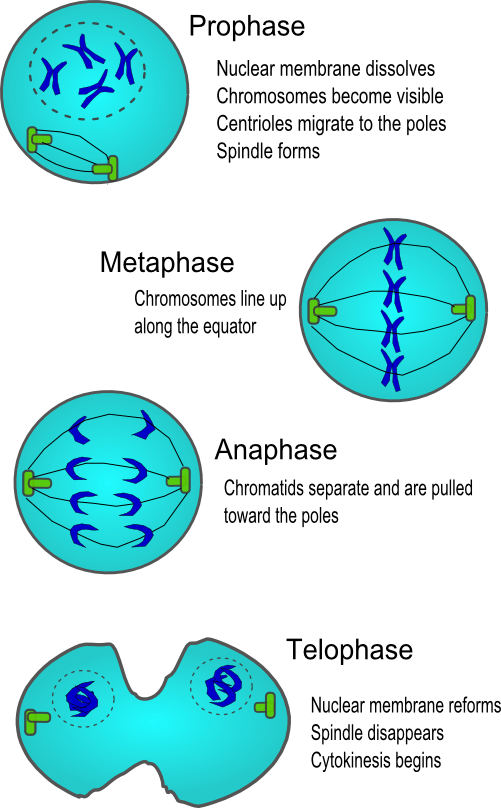
During cell division many changes occur. Cell division is often only described as the mitotic phase of a cell, but mitosis is a series of stages not just one. It begins with prophase, which is when microtubules in the cytoplasm begin to form the spindle. At the same time, the chromosomes in the cell become compact, the nucleoli disappear, and the chromosomes migrate to the poles of the cell. The spindle microtubules and chromosomes meet in the prometaphase. By the time the spindle is completely formed, metaphase begins. During this phase the chromosomes line up in the middle, or equator, of the cell. When learning about the process of cell division, many people associate the word "middle" with metaphase because it is easy to conclude that when all chromosomes are in the middle of a cell there is no doubt that it has to be in metaphase. The chromosomes spit up and are pulled to opposite sides of the cell, which begins the anaphase stage. Chromosomes on both sides become enveloped with another nuclear envelope, making a nucleus on both sides. The spindle formed in prophase disappears, and cytokenesis begins. Cytokenesis divides the cell into two seperate cells and those cells begin the process all over again. Like Virchow's principle states, every cell comes from another cell.

Sources: Class Notes-Chapter 8: The Cellular Basis of Reproduction and Inheritance

Sunday, September 9, 2012

Deforestation: The Effects

electrictreehouse.com
www.telegraph.co.uk
We all know that deforestation isn't good for our planet. Cutting down our Earth's precious trees at such a rate that we are/have been doing can only have negative effects. One of those effects is the decrease in rainfall. Without rainfall, our planets vegetation could no longer survive. The tropical areas of the Earth have the most abundant amount of rainfall due the amount of forests they have. Scientists have been trying to prove that there is a direct link between the amount of forest and the amount of rainfall it gets. A recent study from researchers out of England's University of Leeds shows that in areas in the Amazon region have already been greatly affected by the amount of deforestation that has occurred. The study also showed that if it continues at the rate it is going now, rainfall for those areas could be reduced by as much as 20 percent in the next 40 years. This means we need to take action now, or lose our precious forests we have been blessed with.
Sources: http://news.yahoo.com/less-forest-less-rain-deforestation-reduces-tropical-rainfall-214509180.html